
The Vibe® by VAIL
Five senior researchers left the Ethereum Foundation to build Ethlabs, a nonprofit focused on the practical, pro-ETH work the EF is now deliberately stepping away from. The real story is governance fragmentation: Ethereum is transitioning from a single-steward foundation model to a multi-steward system where accountability is enforced by fundraising cycles, not internal politics.
EF is narrowing to ‘protect what should not change’ — self-sovereignty, core values, open-source AI. Ethlabs takes the ‘what should change’ side.
Ethlabs has 2-3 years of runway from ETH holders and builders, creating an accountability loop: if value isn’t visible in a year, funding dries up.
Ansgar admits the ETH value story is ‘vague and undefined’ after five years at the $100B+ tier — and positions Ethlabs to fix that through intentionality, not a specific mechanism.
The L2 relationship is framed as a value-proposition gap, not an extraction problem: fix the superpower of being in the Ethereum ecosystem first, then have the value-sharing conversation.
Ethlabs plans to scale to ~20 people, hiring exceptional generalists now and targeted specialists per workstream later.
Guests
Ansgar Dietrichs -- Co-founder, Ethlabs
Why this guest matters: One of Ethereum’s most-cited protocol researchers and former EF insider leading the spinout that defines Ethereum’s shift to a multi-steward governance model.
Key Narratives
The EF Narrows, Ethlabs Inherits the Practical Layer
The Big Picture: The Ethereum Foundation has decided to assume a smaller role focused on protecting core values — self-sovereignty, cypherpunk principles — and is cutting its budget 40%. Ethlabs fills the gap: DeFi, agentic finance, institutional adoption, and L1 scaling work that the EF no longer prioritizes because it doesn’t intersect with core values. The division of labor is intentional: EF is the conservator, Ethlabs is the evolution engine.
Why It Matters: This is Ethereum’s first real test of distributed development governance. If the two organizations complement well, the multi-steward model becomes a template for protocol evolution. If they collide or leave gaps, it validates centralized foundation control as the safer model.
The ETH Value Accrual Problem Is Now Centered
The Big Picture: Ansgar openly acknowledges Ether has been stuck at the $100B+ tier for five years with no clear story beyond the L1 burn mechanism. He doesn’t offer a solution but positions intentionality as the prerequisite — every design decision should be made with a clear role for ETH in mind. He cites the irony that ETH currently has worse interop properties than USDC, which can teleport between chains via CCTP while native ETH cannot.
Why It Matters: The ETH underperformance narrative has been a community grievance for years. Ethlabs is the first organization explicitly mandated to be intentional about ETH’s value story, and the 2-3 year funding cycle means the market will judge results on a clear deadline.
L2 Value Sharing Is a Demand Problem, Not a Supply Problem
The Big Picture: Ansgar reframes the ‘L2s don’t pay enough to Ethereum’ complaint: the issue isn’t extraction, it’s insufficient value creation. He argues the superpower of being an Ethereum L2 isn’t strong enough yet to justify demanding more revenue share. Fix the value proposition first, then negotiate sharing. He notes L2s have told him they’d be willing to pay more if Ethereum made the ecosystem more valuable.
Why It Matters: This challenges the dominant community narrative that Ethereum gave away blockspace too cheaply. If Ansgar is right, the path to L2 value recapture is building network effects, not repricing blobs.
Between The Lines
Ansgar’s repeated use of ‘intentionality’ (fees, ETH’s role, L2 relationships) is a polite critique of the EF’s historical design-by-accident approach — EIP-1559’s burn and blob pricing were never economic decisions, they were technical mechanisms with economic side effects.
The ‘we were jaded by the lack of accountability that comes with a nonprofit with infinite money’ comment reveals the core motivation: Ethlabs exists to create a funding-dependent accountability loop that the EF structurally cannot have.
By choosing nonprofit status despite initially exploring for-profit models, Ethlabs signals that roadmap influence is the product, and that neutrality is the currency for earning it. The funding structure from ETH holders and builders is the alignment mechanism, not equity.
Ansgar’s admission that he ‘doesn’t have a perfect answer’ on ETH value but insists the question must be ‘properly centered’ is a deliberate lowering of expectations — the deliverable is intentionality, not a tokenomics redesign.
The 20-person target and emphasis on AI leverage suggest Ethlabs will be a precision instrument, not a parallel bureaucracy. The org is designed to ship, not to employ.
Opportunities
For Founders
DeFi builders on Ethereum have a new, explicitly pro-DeFi organization to approach with protocol-level friction points. Ethlabs is actively soliciting pain points and has already engaged Hayden from Uniswap. If your bottleneck is at the EIP level or L1/L2 interaction layer, this is your window.
If you’re building cross-chain liquidity infrastructure, Ethlabs is signaling interop between zones as a priority workstream — relevant for teams building native asset bridging, cross-chain DeFi composability, or L2 settlement primitives.
For Investors
The 2-3 year funding runway means Ethlabs will need follow-on capital. Investors holding significant ETH who want to see protocol-level work that benefits the asset have a structured vehicle to fund — but the accountability loop means you’ll evaluate results before committing more.
Watch for Ethlabs’ work on ETH’s interop properties (currently worse than USDC’s CCTP). Fixing this could materially improve ETH’s utility as collateral across L2s, which has direct implications for ETH’s competitive position against stablecoins in DeFi.
For Operators
The EF’s narrowing means former EF-aligned operators doing practical DeFi, agentic finance, or institutional adoption work may find a better institutional home at Ethlabs. Key hires coming: generalists with ‘exceptional talent’ now, targeted specialists per workstream in weeks.
Ethereum client teams and external contributors already collaborate on the roadmap informally. Ethlabs formalizes a second major non-EF contributor. Protocol engineers should treat Ethlabs as a legitimate pathway to influence Ethereum’s direction.
For Traders
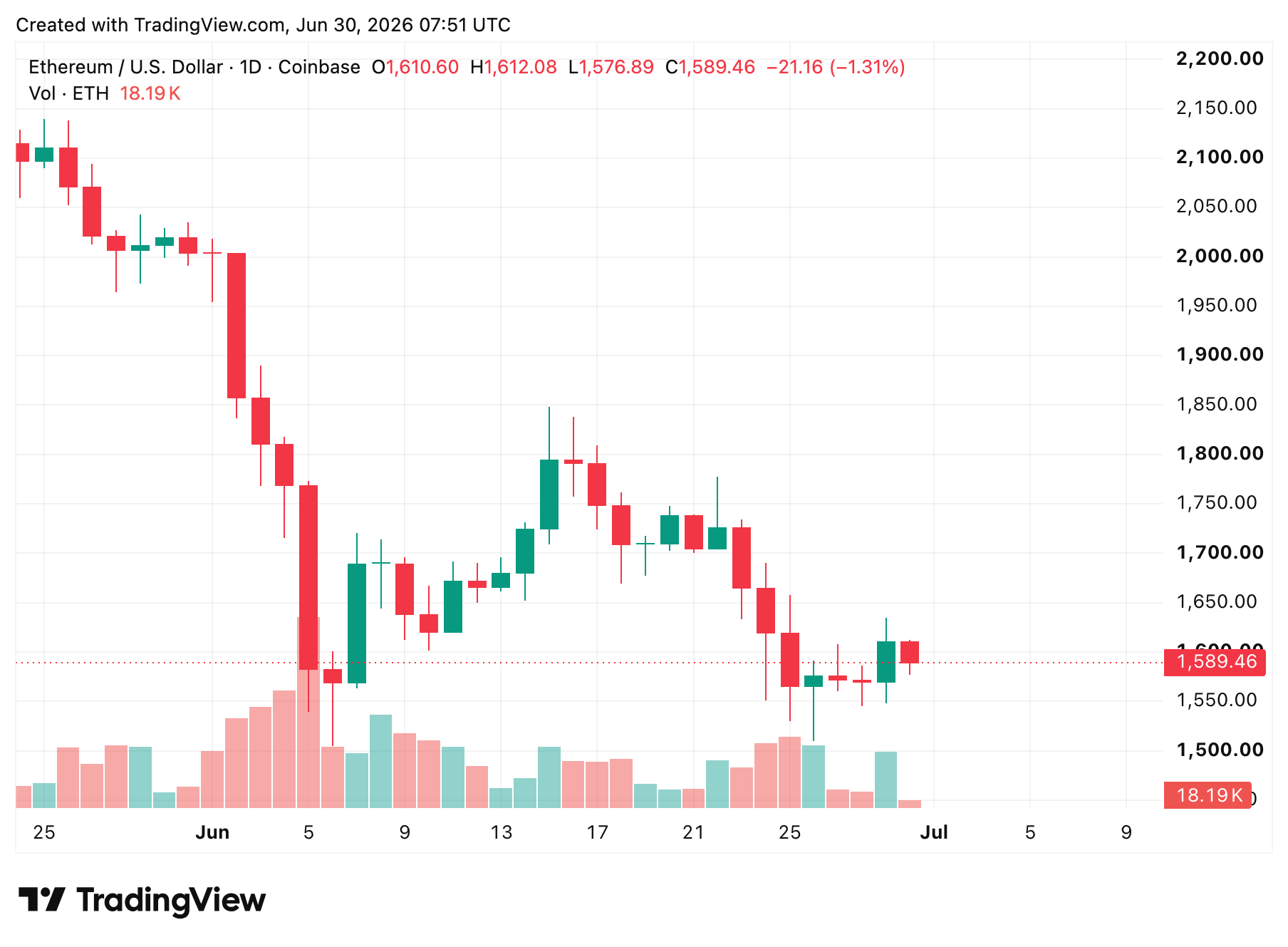
ETH’s value story being ‘vague and undefined’ is already priced in — the market has penalized Ethereum for lacking a clear narrative vs. Bitcoin’s store-of-value story. Any progress from Ethlabs on formalizing ETH’s role is asymmetric upside.
The L2 value-sharing reframing means don’t expect near-term blob fee increases or L2 repricing. Ansgar’s framework suggests Ethereum will try to grow the pie before demanding a larger slice — bearish for short-term L2 fee compression narratives, neutral-to-bullish for L2 token valuations.
Watch for Ethlabs deliverables on native ETH interop (teleporting ETH between chains). If solved, ETH becomes a first-class cross-chain asset again, potentially increasing its DeFi collateral dominance at the expense of stablecoin-based bridges.
Contrarian View
Multi-steward Ethereum may be a governance regression, not progress
The EF’s narrowing is being framed as healthy division of labor, but it could equally be read as institutional fragmentation at the worst possible moment. Ethereum faces competitive pressure from Solana’s single-shard simplicity and Bitcoin DeFi’s institutional momentum. Splitting protocol work across the EF (values), Ethlabs (practical evolution), Etherealize (institutional bridge), Consensys (commercial infrastructure), and independent client teams creates coordination overhead — exactly the kind of overhead that fast-moving competitors don’t carry. A 2-3 year funding cycle forces short-term visible wins, which could bias Ethlabs toward incremental improvements rather than the kind of foundational protocol changes that take 5+ years. The accountability loop Ansgar praises may actually prevent the patient, long-horizon work that protocol evolution requires.
What To Watch
Ethlabs’ first targeted job postings — the specific workstream titles will reveal whether they’re genuinely pursuing DeFi/agentic finance or defaulting to their core competency of L1 protocol work.
Whether the EF publicly cedes specific roadmap items to Ethlabs, or whether overlap and territorial friction emerges. Ansgar mentioned the EF has already told them ‘we will no longer allocate resources to this’ on some topics — watch for which ones.
Progress on native ETH interoperability — Ansgar flagged ETH having worse cross-chain properties than USDC as a specific problem. This is a solvable technical issue that could be an early visible win.
The next round of Ethlabs funding in 12-18 months — who re-ups, who drops out, and whether the accountability loop actually functions as designed.
Whether Ethlabs takes a public position on blob pricing or L2 fee mechanisms — this is the first real test of whether they can be ‘opinionated’ in ways the EF culturally couldn’t.
Bold Takes
I really think it’s either Ethereum or no one, but it’s not automatically going to be Ethereum.
Ansgar Dietrichs, 18:21
Why This One: Frames the existential stakes of Ethereum’s role as a global settlement layer as a live question, not a foregone conclusion.
The fee burn was also never intentional. EIP-1559 is in principle just a scarcity management mechanism.
Ansgar Dietrichs, 38:24
Why This One: Directly critiques Ethereum’s most celebrated tokenomics innovation as an accidental economic feature of a technical mechanism.
Today, I don’t think that value exists enough in the first place. So I would rather start by focusing on increasing the value proposition.
Ansgar Dietrichs, 46:46
Why This One: Reframes the L2 value-sharing debate from ‘Ethereum got robbed’ to ‘Ethereum hasn’t built enough value to share’ — the opposite of the dominant community narrative.
ETH in a way has the worst interop properties of any asset in the Ethereum ecosystem.
Ansgar Dietrichs, 36:39
Why This One: Identifies a concrete, solvable deficiency where Ethereum’s native asset is functionally inferior to a stablecoin within its own ecosystem.
Heat Map
🔥🔥🔥🔥🔥 Ethereum multi-steward governance model
Fire Factor: The launch of Ethlabs formalizes the split of Ethereum’s most protocol-influential talent from the EF, testing whether distributed development can match the coherence of a single foundation.
🔥🔥🔥🔥🔥 ETH value accrual and tokenomics intentionality
Fire Factor: Ansgar centering the ‘vague and undefined’ ETH value story as a problem to fix — rather than defending existing mechanisms — signals a potential paradigm shift in how Ethereum designs for its native asset.
🔥🔥🔥🔥 L1/L2 value sharing and blob pricing
Fire Factor: The argument that Ethereum should focus on creating L2 ecosystem value before demanding revenue share challenges the community’s dominant extraction narrative.
🔥🔥🔥🔥 EF budget cuts and narrowing scope
Fire Factor: The EF’s 40% budget reduction and focus on core values creates the structural gap Ethlabs exists to fill — the cause and effect of the entire conversation.
🔥🔥🔥 DeFi as Ethereum’s primary use case
Fire Factor: Ansgar’s push for Ethereum to be more opinionated about DeFi as the main value proposition signals a cultural shift from big-tent neutrality toward strategic focus.
🔥🔥🔥 Native ETH interoperability vs. stablecoins
Fire Factor: The admission that ETH has worse cross-chain properties than USDC surfaces a concrete, fixable deficiency with direct implications for ETH’s DeFi dominance.